Electrical Panel Upgrade
Residential and commercial 100A → 200A or 400A main panel upgrades across the Wasatch Front. NEC-2023 compliant, permit-pulled, Rocky Mountain Power coordinated.
Permitted 100A to 200A (and 400A) panel upgrades across the Wasatch Front
If your home still runs on a 100-amp panel — or worse, a Zinsco or Federal Pacific board that insurance companies now flag — a panel upgrade is usually what unlocks everything else: EV charging, a hot tub, a basement finish, an induction range. We pull the permit, do a proper load calculation per NEC Article 220, and coordinate the service drop with Rocky Mountain Power so you're not left without power longer than you need to be.
Most of our residential upgrades land at 200A, which handles a modern household with room to grow. If you're planning a shop, a detached ADU, or heavy EV charging — the kind of setups we see a lot in Alpine, Mapleton, and Heber — we'll talk through whether 400A makes sense before we quote it. 400A isn't the default answer; it's the honest answer when the load calc actually calls for it. We walk you through the plan before anything comes off the wall.
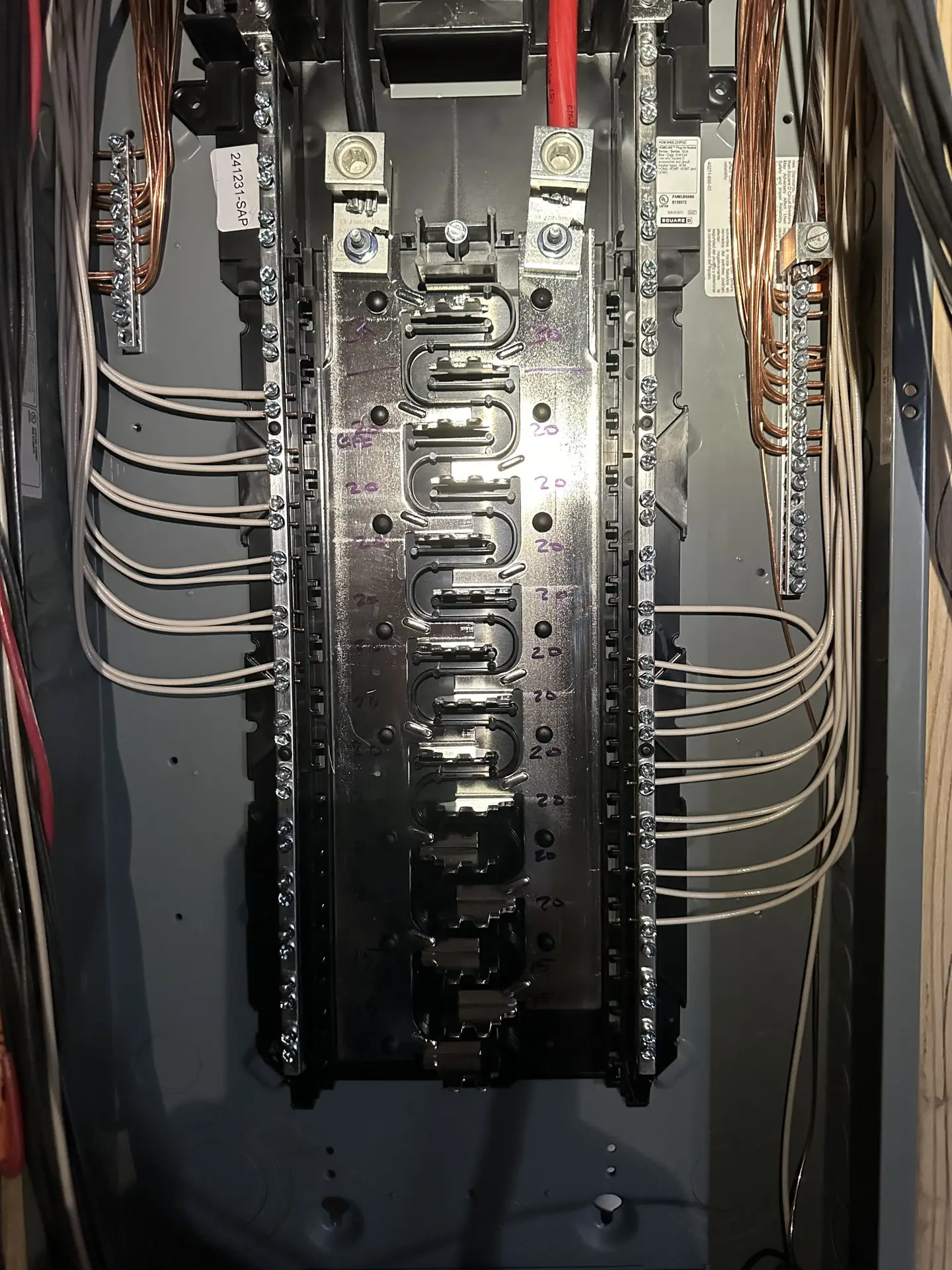
A real panel upgrade isn't just swapping a box. We replace the meter base when it's weather-tired or the wrong rating, re-pull the service entrance conductors if the existing ones won't carry 200A, bring the grounding electrode system up to current code (two driven rods bonded together, plus a water pipe bond where applicable), and add intersystem bonding so your cable, phone, and future solar install all tie into the same ground reference. That's what NEC 250 is after, and it's what inspectors look for.
Zinsco and Federal Pacific Stab-Lok panels are the two we see most often in homes built roughly 1960 through the mid-1980s across Springville, Provo, Orem, and Payson. Both have documented failure histories where the breaker simply doesn't trip under fault — which is the one job a breaker exists to do. We won't scare you about it, but once we have the system open, replacing one of those is almost always the right move, and your insurance carrier likely agrees. We've swapped out dozens of these across Utah County alone.
We're a small, family-run shop based in Springville, so when you call for a panel upgrade quote, you'll get me or someone on our crew walking your service — not a commissioned closer trying to sell you a 400A you don't need. If the honest answer is "stay at 100A, add this one circuit, come back in five years," we'll say that. We'd rather earn the next job than oversell this one.
Signs it’s time.
Your panel is a Zinsco or Federal Pacific Stab-Lok
Both brands have known failure modes where breakers don't trip under fault. Insurance carriers increasingly require them to be replaced, and we see them all over 1960s–80s Utah homes.
Breakers trip when a few things run at once
If running the microwave while the dryer's on knocks out a circuit, you're either overloaded or your panel is undersized for how you actually use the house today.
You're planning an EV, hot tub, or basement finish
Big new loads need a load calculation. On a 100A service, there often isn't headroom to add a 50A tub plus a Level 2 charger — a 200A upgrade is the honest answer.
Home inspection flagged double-tapped breakers or no main
Old split-bus panels and double-tapped breakers show up in nearly every pre-sale inspection on homes built before 1985. We clean it up to current code.
Our process, step by step.
No mystery, no sales games. Here’s exactly what happens from the first phone call to the final inspection.
We walk your service and do a load calculation
First visit, we open the existing panel, document every circuit, check the condition of the meter base and service entrance, and run an NEC Article 220 load calc based on your actual home — square footage, appliances, HVAC, planned additions. That number drives whether you need 200A or 400A, not a round guess.
We write a firm, line-item quote
You get a written quote covering the panel, meter base if needed, service entrance work, grounding and bonding upgrades, permit fees, and inspection. If we think a sub-panel or a specific circuit upgrade should ride along, we'll flag it and let you decide — nothing added at the end.
We pull the permit and schedule Rocky Mountain Power
Once you approve, we pull the electrical permit with your city or county, submit for a Rocky Mountain Power service disconnect, and coordinate a cutover window. RMP typically needs a few business days of notice — we handle the paperwork and the scheduling.
Cutover day: power off, panel swap, grounding upgrade
On the install day, RMP pulls the meter, we remove the old panel, mount the new one, run new service entrance conductors if required, install the new meter base, and bring the grounding electrode system up to current code (new rods bonded, water pipe bond, intersystem bond for cable and phone).
We re-land every circuit on the new panel
Every branch circuit gets moved to the new panel on correctly sized breakers, with AFCI or GFCI protection added where current code requires it. We label each breaker clearly — not just "bedroom" but "northeast bedroom + closet lights" — so future you (or your electrician) knows exactly what's what.
RMP reconnects, we test, inspector signs off
Once we're buttoned up, RMP comes back to re-set the meter, we power up and test every circuit, confirm GFCI and AFCI protection trips correctly, and schedule the city inspection. We're on-site when the inspector walks it so any questions get answered right there.
Walkthrough and documentation handoff
Before we leave, we walk you through the new panel — where the main is, what each breaker controls, how to reset a GFCI or AFCI — and hand you the permit sign-off, load calc, and photos for your records (and your insurance carrier if they asked).
Our scope for this job.
- NEC Article 220 load calculation sized to your actual home and future plans
- Permit pulled with your city or county, inspection scheduled and attended
- Rocky Mountain Power service disconnect and reconnect coordination
- New main breaker panel, grounding electrode system, and intersystem bonding
- All existing circuits re-landed on new breakers, labeled clearly
- Weather-sealed meter base and service entrance conductors as needed
- Final walkthrough so you know what's where before we leave
What people ask about panel upgrade.
How long will I be without power?
Most straightforward 200A swaps are a one-day job with the power off for roughly four to six hours during the service cutover with Rocky Mountain Power. If the meter base or service mast needs replacing too, we plan for a longer outage window and we tell you up front — nobody likes a surprise cold fridge.
Do I really need 200A, or can I stay at 100A?
It comes down to a load calculation, not a guess. If your gas appliances are staying gas and you don't plan to add EV charging or electric heat, 100A can be fine. The moment EVs, heat pumps, or hot tubs enter the picture, 200A almost always wins.
What does a panel upgrade cost?
It depends on panel size, whether the meter base and service entrance need replacing, how far the main is from the meter, and what the utility coordination looks like. We walk your setup, do the load calc, and give you a firm written quote — no surprise line items at the end.
Is a Federal Pacific or Zinsco panel actually dangerous?
Both have documented history of breakers failing to trip under overload or short circuit, which is the one job a breaker exists to do. We won't scare you about it, but we also won't leave one in place when we're already touching the system — your insurance carrier likely feels the same way.
Will my old circuits still work after the upgrade?
Yes — we move every existing branch circuit over to the new panel and label it. If we find older issues along the way (shared neutrals, aluminum branch wiring, missing GFCI protection), we'll point them out and let you decide whether to address them now or later.
Do I need to be home during the panel upgrade?
Someone needs to be there at the start so we can walk the house and confirm what's on each circuit, and again at the end for the walkthrough. The middle hours — while we're cutting over with Rocky Mountain Power and relanding circuits — you're welcome to leave. Most clients run errands.
What's the difference between 200A and 400A, and who actually needs 400A?
200A is the modern standard for a single-family home and handles pretty much any realistic household load — including EV charging, central AC, and electric cooking. 400A comes into play when you have a detached shop with heavy equipment, an ADU with its own kitchen and HVAC, two EVs plus a hot tub plus electric heat, or future solar with large battery storage. We size it off the actual load calculation, not off a round number.
Will my insurance company require a panel upgrade?
Increasingly, yes — especially if you have a Federal Pacific Stab-Lok, Zinsco, or certain Pushmatic panels. Carriers are either refusing to write policies on homes with those panels or requiring remediation at renewal. We produce a documentation package (permit, inspection sign-off, photos) that insurers accept.
Can I keep my old sub-panel when the main gets upgraded?
Usually, yes — a sub-panel downstream of the main doesn't automatically need to be replaced when we upgrade the main service. We'll inspect it and verify the feeders are adequate, the grounding and neutral bonding are correct for a sub-panel (neutrals and grounds separated, no bonding screw), and that it isn't itself a Federal Pacific or Zinsco. If it checks out, we leave it.
What's a split-bus panel and why do inspectors flag it?
Split-bus panels, common in homes built roughly 1950-1980, don't have a single main breaker — they use several 60A breakers at the top of the panel to feed different sections, and you shut power off by flipping multiple breakers. The problem is they're often undersized for today's loads, and if any one of those section breakers fails, you've got no easy way to shut the whole house down. Modern code requires a single main disconnect, which is why these come up on every pre-sale inspection in Provo and SLC-era homes.
We serve Salt Lake County, Utah County, Wasatch County, Davis County from our Springville base. See all service areas →
Other things we handle.
Need an electrician for your Utah home?
Panel upgrades, EV chargers, generators, aluminum wiring, remodels, and everything in between — from a licensed, family-run team that takes the time to explain what we’re doing.